Aga Ruhullah Resigns: Lok Sabha, Article 101 & NC Crisis
In this article
What happened today
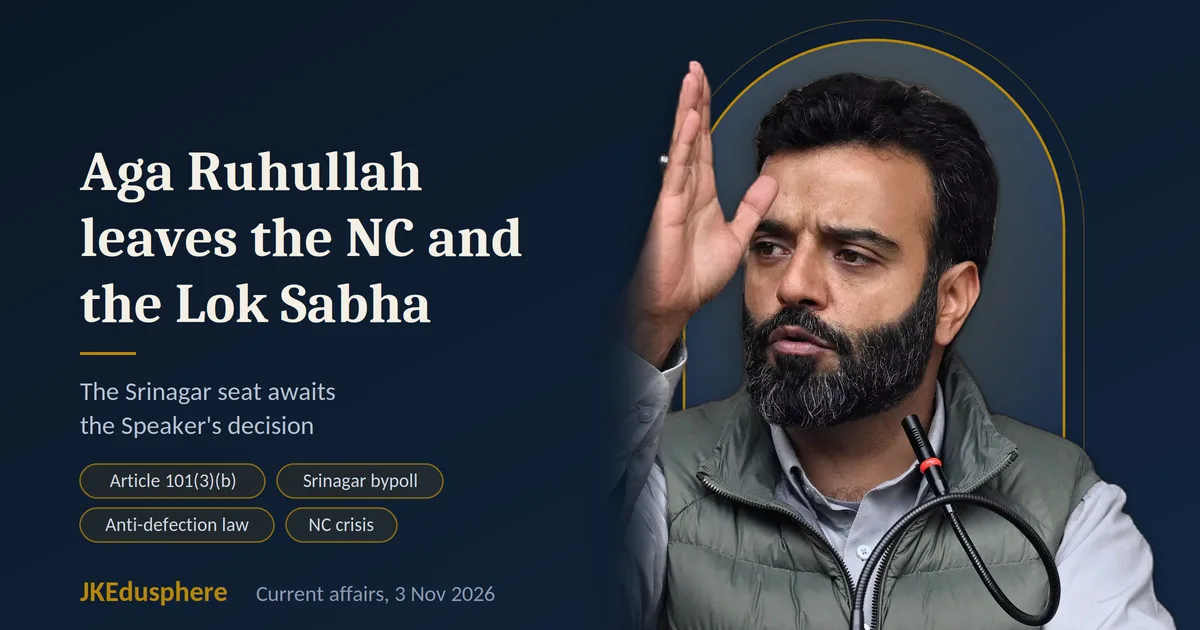
On 3 November 2026, Srinagar MP Aga Syed Ruhullah Mehdi announced that he is leaving both the National Conference (NC) and the Lok Sabha. He chose a public gathering at Behisti Zehra Park, Budgam, on the 26th death anniversary of his father, Aga Syed Mehdi.
His resignation letter to Lok Sabha Speaker Om Birla invokes Article 101(3)(b) of the Constitution and Rule 240 of the Lok Sabha Rules of Procedure. He calls the resignation "voluntary and genuine" and asks for it to be accepted. He told reporters the letter was being sent to the Speaker by email.
His main charge: the NC used him to win votes in 2024 and then abandoned its promises, namely restoration of Article 370, release of prisoners and free electricity. He said he could no longer be part of what he called lies, and described the move as setting himself free. He attacked Chief Minister Omar Abdullah and NC president Farooq Abdullah, and hinted at launching a new political outfit.
Status check: the resignation takes effect only when the Speaker accepts it. Reports available at the time of writing describe the letter as sent, but none confirms acceptance, so the Srinagar seat has not yet been declared vacant.
How we got here
- 2020: Ruhullah quit as NC chief spokesperson after Omar Abdullah's statement that he would not contest elections while J&K remained a Union Territory. He argued the party's main demand should be restoration of special status, not statehood.
- 2024: The NC fielded him from Srinagar. He defeated the PDP's Waheed-ur-Rehman Para with 3,56,866 votes to 1,68,450, a margin of about 1.88 lakh.
- Months after the 2024 Assembly elections: relations began to sour.
- 2026: Farooq Abdullah publicly dared him to resign and face a fresh election, asking whether he had ever won without NC backing. In August Ruhullah signalled he would quit, and on 30 October his office announced 3 November as the date.
- Budgam bypoll: Ruhullah stayed away from the campaign. The NC lost the seat, which Omar Abdullah had vacated in 2024, to the PDP. He was also not invited to the NC working committee meeting that followed.
The constitutional perspective
Article 101(3)(b): how an MP resigns
A Member of Parliament may resign by writing under their hand to the Speaker (or the Chairman, for Rajya Sabha). The seat falls vacant when the resignation is accepted.
A proviso, added by the 33rd Constitution Amendment Act, 1974, says the Speaker shall not accept a resignation if satisfied that it is not voluntary or genuine. This is why Ruhullah's letter stresses both words. In practice the Speaker may seek the member's confirmation before accepting. Until acceptance, a member can generally withdraw the resignation.
The six-month rule for a by-election
Under Section 151A of the Representation of the People Act, 1951, a vacancy in Parliament must be filled within six months of its occurrence, provided the remainder of the term is one year or more. The 18th Lok Sabha, which first sat in June 2024, runs to mid-2029, so the Srinagar bypoll is legally required. The Election Commission can defer it only if, in consultation with the Centre, it certifies that holding it within six months is difficult.
The anti-defection angle (Tenth Schedule)
Paragraph 2(1)(a) of the Tenth Schedule disqualifies a member who voluntarily gives up membership of the party on whose ticket they were elected. Had Ruhullah quit the NC but kept his seat, the NC could have petitioned the Speaker for his disqualification. The Speaker decides such petitions, subject to judicial review (Kihoto Hollohan, 1992), and these decisions have often been slow and politically contested.
By resigning the seat as well, he avoids that fight altogether and turns the question into a clean electoral test. Whether the move was designed this way is his own claim to make, but the legal effect is clear: no disqualification case, and he remains free to contest the bypoll.
The larger constitutional backdrop: Article 370 and statehood
Ruhullah's grievance rests on a question that the courts have already largely settled.
- Article 370 was abrogated on 5 August 2019, and J&K was reorganised into a Union Territory with a legislature under the J&K Reorganisation Act, 2019.
- In December 2023 the Supreme Court (In re: Article 370) upheld the abrogation and directed that statehood be restored at the earliest and elections held by September 2024.
- A J&K Assembly cannot restore Article 370 by itself. Any restoration would need action by Parliament and the President, which makes it a matter between J&K and the Centre. The Assembly passed a resolution on special status in November 2024, but a resolution is a political statement, not a legal remedy.
- Under Union Territory rules, the Council of Ministers is capped at 10% of the 90-member Assembly, so nine, including the Chief Minister. This cap shaped the 27 October cabinet expansion that triggered the MLAs' unrest.
This is the structural trap for any J&K government. It must make promises on Article 370 and statehood to win votes, but the power to deliver them lies in Delhi.
What changes in the Lok Sabha
- Effective strength: the House falls to 542 effective members until the bypoll. Srinagar has no representative in the interim, which is normal for a vacancy of up to six months.
- NC's tally: the NC won two Lok Sabha seats in 2024. It drops to one, assuming the second MP stays loyal.
- Arithmetic of power: no change in the balance between the ruling alliance and the opposition. The NC sits with the opposition INDIA bloc, and one seat does not alter that.
- Speaker's role: acceptance is within the Speaker's domain. Watch for the timing of acceptance and whether the Election Commission announces a Srinagar bypoll, possibly clubbed with other vacancies.
What changes in the NC and the J&K government
The Omar government is not directly threatened
Ruhullah is a Lok Sabha member, not an MLA, so his exit does not alter the Assembly arithmetic. The numbers in the 90-member House, as reported:
- NC: 41 MLAs (42 won in 2024, and the party then lost the Budgam bypoll to the PDP)
- Congress: 6 (outside the ministry; it has said it will not take cabinet berths until statehood is restored)
- Independents supporting the government: 4
- CPI(M): 1
- Majority mark: 46
This is a comfortable cushion on paper. The real pressure is internal.
The real stress: the MLA revolt
On 31 October, 18 NC MLAs submitted an eight-point memorandum to Farooq and Omar Abdullah. They sought a fresh cabinet restructuring, removal of the Chief Minister's advisor, and a time-bound roadmap for implementing the party manifesto. Some reports claim support from 24 or 25 MLAs, but these figures are unverified.
The trigger was the 27 October expansion, which inducted four Valley-based NC MLAs, was seen as carrying Farooq Abdullah's stamp, left out several of Omar's close aides, and dropped independent MLA Satish Sharma. The expansion also tilted the cabinet toward the Kashmir Valley.
A useful point for aspirants: if rebel MLAs actually withdrew support or voted against the party whip, the Tenth Schedule would expose them to disqualification unless two-thirds of the legislature party (28 of 41) merged with another party. The reported rebel numbers fall short of that, which is why the dissent works more as pressure for concessions than as an immediate threat to the government.
The Centre
No change in the Union government. The NC is not part of the NDA. The BJP reacted sharply to the cabinet expansion, and it will likely use Ruhullah's exit to argue that the NC's Article 370 rhetoric was only election posturing, while the NC will say the issue is in court and in Parliament, not in its hands. Remember also that under the UT framework the Lieutenant Governor retains significant powers, so the elected government's room to act is limited.
The party perspective
National Conference. It loses a popular campaigner and a prominent Shia face in the Srinagar-Budgam belt. It must now contest a Srinagar bypoll shortly after losing Budgam, with a charge of family-centred decision-making already circulating among its own legislators. Omar Abdullah has said earlier that changes in government or party would be made if necessary.
Ruhullah Mehdi. By resigning the seat, he effectively accepts Farooq Abdullah's challenge to face voters. His risk is contesting without the NC's organisation. His strength is a personal base, a religious-political family legacy and the 2024 vote, though a large part of that vote was NC-backed. Whether he forms a new party or joins an existing one is speculation for now.
PDP. Waheed Para was runner-up in Srinagar in 2024, and the PDP has just won Budgam. A three-way contest with the NC and Ruhullah could reshape the Valley's vote.
Congress. The alliance partner sits outside the cabinet and has little to gain from the NC's turmoil, but it could face pressure to choose sides in the bypoll.
BJP. It will watch the NC's weakening and the vote split, but it has little presence in the Srinagar seat.
The arguments on both sides: Ruhullah's supporters say he is keeping faith with the mandate on which he was elected and paying a personal price to do it. The NC's defenders say he is leaving after being given a ticket and a platform, that governing under UT constraints requires pragmatism, and that the bypoll will show who voters back.
Quick facts for exam aspirants
- Article 101(3)(b): resignation of an MP, in writing to the Speaker or Chairman
- 33rd Amendment (1974): added the voluntary-and-genuine check
- Rule 240, Lok Sabha Rules of Procedure: the procedural rule on resignation
- Section 151A, RP Act 1951: bypoll within six months if one year or more of the term remains
- Tenth Schedule: disqualification for voluntarily giving up party membership; two-thirds merger exception
- J&K cabinet cap: 10% of 90, so 9 ministers
- Article 370: abrogated 5 August 2019; abrogation upheld by the Supreme Court in December 2023
What to watch next
- Whether and when the Speaker accepts the resignation
- Whether the Election Commission schedules the Srinagar bypoll
- Ruhullah's next political move: a new party or an alliance
- How the NC leadership answers the MLAs' eight-point memorandum
- Congress's position on the bypoll
Practice before the exam
Take a free mock test with solutions and a live leaderboard.