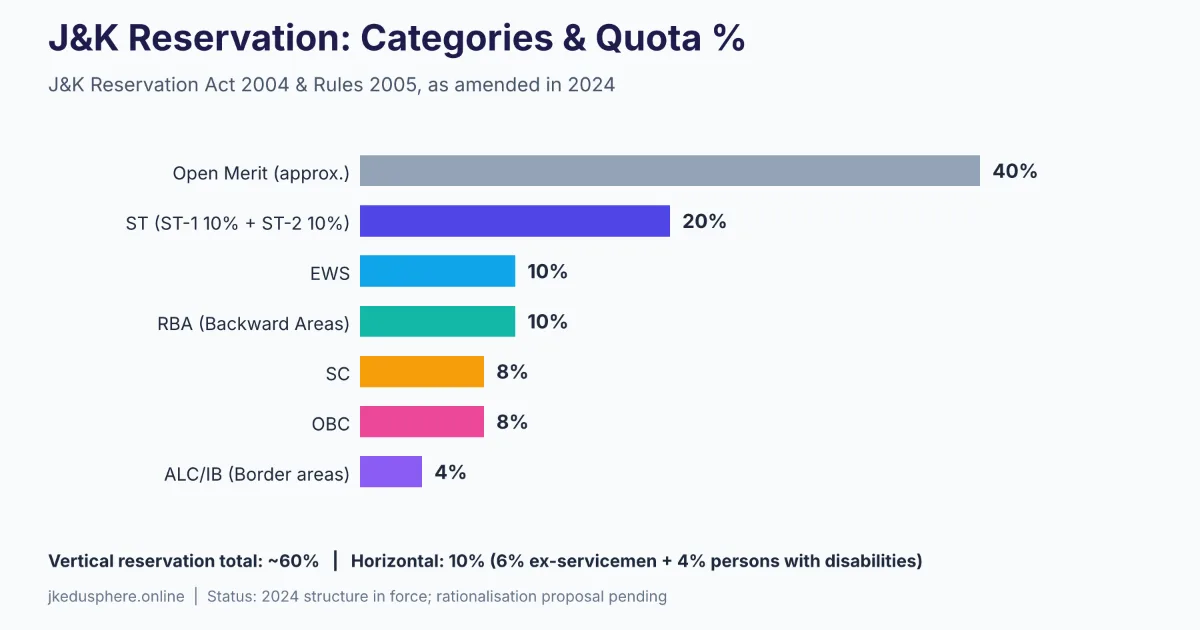
Reservation in Jammu & Kashmir is governed by the J&K Reservation Act, 2004 and the J&K Reservation Rules, 2005, amended in March and May 2024. Vertical reservation is about 60% (SC 8%, ST 20%, EWS 10%, RBA 10%, OBC 8%, ALC/IB 4%), plus 10% horizontal reservation (6% ex-servicemen, 4% persons with disabilities). Open Merit is about 40%. A rationalisation proposal approved by the Cabinet in December 2025 is pending with the competent authority, so the 2024 structure appears to remain in force.
1. Legal Framework
The parent law is the J&K Reservation Act, 2004, with the J&K Reservation Rules, 2005 framed under it. The Rules were amended in March and May 2024.
These amendments followed:
- The J&K Reservation (Amendment) Act, 2023
- The Scheduled Castes and Scheduled Tribes Order (Amendment) Acts, 2024
- Recommendations of the J&K Socially and Educationally Backward Classes Commission
The Administrative Council approved the amendments on 15 March 2024. They were notified through orders including SO 176 dated 15.03.2024 and SO 305 dated 21.05.2024.
After Article 370 was abrogated, 10% EWS reservation was extended to J&K under the 103rd Constitutional Amendment.
2. Current Quota Structure in J&K
Reservation works on two layers. Vertical reservations are fixed by category. Horizontal reservations cut across them.
Vertical Reservation
| Category | Quota |
|---|---|
| Scheduled Caste (SC) | 8% |
| Scheduled Tribe (ST) | 20% |
| Economically Weaker Section (EWS) | 10% |
| Residents of Backward Areas (RBA) | 10% |
| Other Backward Classes (OBC) | 8% |
| Actual Line of Control / International Border (ALC/IB) | 4% |
| Total vertical | About 60% |
Category Details
- ST split: ST-1 covers Bakarwal, Gujjar, Brokpa and others listed earlier. ST-2 covers tribes added in 2024, including the Pahari Ethnic Group, Paddari, Koli and Gadda Brahmin. Each gets 10%.
- OBC: the 8% quota includes 15 newly added groups.
- RBA: Residents of Backward Areas. This quota was once 20%, later cut to 10%.
- ALC/IB: residents living near the Line of Actual Control or the International Border.
Horizontal Reservation
| Category | Quota |
|---|---|
| Ex-servicemen | 6% |
| Persons with disabilities | 4% |
| Total horizontal | 10% |
The High Court has held that the 4% disability quota is an overall horizontal reservation, adjusted within each vertical category by merit.
Net effect: vertical reservation is about 60%, so Open Merit is about 40% before horizontal adjustments. Critics say it falls to roughly 30% in practice.
3. How J&K Reservation Changed
| Category | Before 2019 | After 2024 |
|---|---|---|
| SC | 8% | 8% |
| ST | 10% | 20% |
| OBC | 4% | 8% |
| ALC/IB | 4% | 4% |
| RBA | 10% | 10% |
| EWS | 10% | 10% |
The 2024 changes doubled ST reservation to 20%, doubled OBC reservation to 8%, and brought total reservation to about 70% including horizontal categories.
4. Legal Challenges
- Petitioners argue that the amended rules breach the 50% ceiling set in Indra Sawhney v. Union of India.
- They also argue that Section 3 of the 2004 Act limits each category's reservation to its share of the population.
- The High Court ruled that appointments under the amended rules would be subject to the outcome of the challenge.
- In July 2025, the High Court held that a community's reservation must not exceed its population share. It allowed several petitions on the Rules' validity to be withdrawn because Section 3 of the Act was not challenged.
The government's position is that its policies are meant to ensure equitable development of deserving sections while maintaining merit. Supporters of the quotas argue that reducing them would hurt SC, ST and OBC communities who need these protections.
5. Rationalisation Efforts
| Date | Development |
|---|---|
| 10 Dec 2024 | The Omar Abdullah government formed a Cabinet Sub-Committee on reservation. |
| 10 Jun 2025 | The Sub-Committee submitted its report. |
| Jun 2025 | The Cabinet asked the committee to rework the report to make it legally tenable. |
| Dec 2025 | The Cabinet cleared a new policy and sent it to the Lt Governor. The proposal cuts EWS from 10% to 3% and RBA from 10% to 7%, raising Open Merit to 40% in direct recruitment and nearly 50% under vertical reservations. |
| Mar 2026 | The government told the Assembly the report was pending with the competent authority, with no timeline. |
| Sep 2026 | Reports said the report had been sent to the Ministry of Home Affairs through the LG. |
Current status: no approval of the new policy has been reported, so the 2024 structure appears to remain in force.
6. Points of Contention
- Open Merit students say they compete for too few seats relative to their population share.
- Regional disparity: opposition leaders say only 10 of 55 JKAS and Accounts selectees were from the Kashmir Valley, and they criticise the RBA cut.
- Inter-group friction: ST status for Pahari-speaking people has drawn objections from Gujjar-Bakarwal groups.
- Data gap: commentators note that no updated population data exists to base quotas on.
Frequently Asked Questions (FAQs)
Which law governs reservation in Jammu and Kashmir?
The J&K Reservation Act, 2004 and the J&K Reservation Rules, 2005. The Rules were amended in March and May 2024.
What is the current reservation percentage in J&K?
Vertical reservation is about 60%: SC 8%, ST 20%, EWS 10%, RBA 10%, OBC 8% and ALC/IB 4%. Horizontal reservation adds 10% (6% ex-servicemen, 4% persons with disabilities).
How much is the Open Merit quota in J&K?
About 40% before horizontal adjustments. Critics say it falls to roughly 30% in practice.
What is RBA reservation in J&K?
RBA means Residents of Backward Areas. The quota was once 20% and was later cut to 10%.
What is ALC/IB reservation?
It is a 4% quota for residents living near the Line of Actual Control or the International Border.
What are ST-1 and ST-2 in J&K?
ST-1 covers Bakarwal, Gujjar, Brokpa and others listed earlier. ST-2 covers tribes added in 2024, including the Pahari Ethnic Group, Paddari, Koli and Gadda Brahmin. Each gets 10%.
When did EWS reservation start in J&K?
The 10% EWS quota was extended to J&K after Article 370 was abrogated, under the 103rd Constitutional Amendment.
Does J&K reservation cross the 50% limit?
Petitioners argue that it breaches the 50% ceiling set in Indra Sawhney v. Union of India. The High Court has said appointments under the amended rules are subject to the outcome of the challenge.
What did the High Court say in July 2025?
The High Court held that a community's reservation must not exceed its population share. It allowed several petitions on the Rules' validity to be withdrawn because Section 3 of the Act was not challenged.
What is the rationalisation proposal?
The Cabinet cleared a new policy in December 2025 that proposes cutting EWS from 10% to 3% and RBA from 10% to 7%, raising Open Merit to 40% in direct recruitment and nearly 50% under vertical reservations.
Has the new reservation policy been implemented?
No approval has been reported yet. The 2024 structure appears to remain in force.
Why is the J&K reservation policy controversial?
Open Merit students say they have too few seats. Opposition leaders point to regional disparity and the RBA cut. Gujjar-Bakarwal groups have objected to ST status for Pahari-speaking people. Commentators note there is no updated population data to base quotas on.
Last updated: 6 November 2026. This article is an explainer and not legal advice. Refer to official notifications of the J&K Government and the General Administration Department for the latest orders.